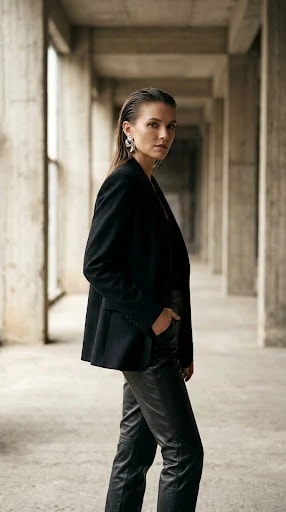
There is a particular kind of quiet that only happens when someone stops walking and turns. In a raw concrete passage, between repeating columns and diffused grey light, everything in this frame points to that half-turn: the shoulder angled forward, the chin clearing the collar, the gaze arriving a second before the rest of the body does. The outfit does the same thing. Black on black on black, with nothing to hide behind, which is exactly why it reads as confident rather than safe. Monochrome is not the absence of a decision; it is the decision made once and made well.
The architecture here is tailoring. An oversized blazer, shoulders clean and structured, worn open so the fitted black top underneath keeps the silhouette from swallowing her. Volume on top, precision below — the leather trousers are cut close and fall straight to the ankle, their surface catching that soft side light in a way matte fabric never will. That contrast is the whole trick: same colour, two textures, one sharp line. If the blazer were cropped short the look would turn jaunty; if the trousers were wide it would go soft. The tension between slouch and severity is what makes it feel edgy instead of merely dark.
Then there is the punctuation. A single pair of large sculptural earrings, catching the daylight at the jaw, doing more work than a stack of rings, a layered chain and a belt combined could manage. One loud element in an otherwise silent composition reads as intent. Add a second statement and the eye has nowhere to land; keep it to one and the whole outfit sharpens around it. This is the discipline minimal chic actually asks for — not fewer things, but fewer arguments.
Grey concrete is an underrated backdrop. It flatters black by giving it somewhere to sit, and it refuses to compete. Repeating columns create vertical rhythm, and the empty floor around her becomes negative space that lets the clean lines of the outfit breathe. The lesson translates off-camera: when you dress in a single tone, choose surroundings — and photographs — that frame the silhouette rather than crowd it. An 85mm compression helps, flattening the corridor and pushing her forward, but a plain wall and good daylight will do the same job.
To rebuild the look, start with the blazer: oversized but not shapeless, hem hitting mid-hip, sleeves pushed to the wrist bone. Add a fitted black top so the volume has something to fall against, then leather or coated trousers with a straight leg and a break that skims the shoe. Finish with one bold earring, hair pulled back or tucked, and no bag in hand if you can manage it. The point of the look was never the clothes alone. It is the willingness to stand in an empty room, in one colour, and let the tailoring speak.